
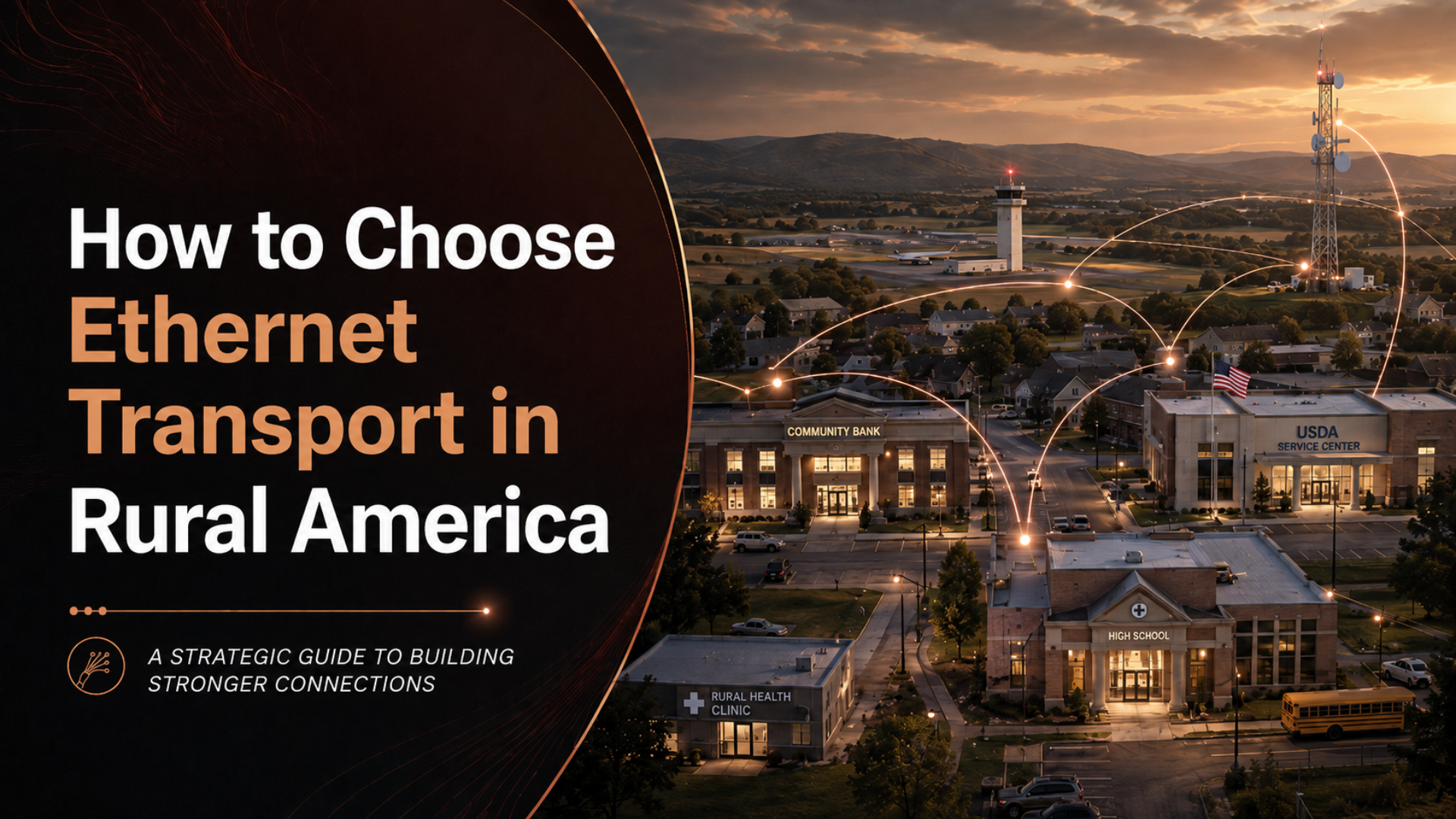
How to Choose Ethernet Transport in Rural America
Wholesale carriers expanding into rural and underserved U.S. markets face a unique set of challenges that urban-focused network strategies simply can’t address. From scattered last mile providers to limited infrastructure density, the path to reliable Ethernet transport in rural America requires a fundamentally different approach than metropolitan deployments.
This guide walks you through the key decision criteria for selecting Ethernet transport solutions that deliver scalable bandwidth, dependable coverage, and simplified operations across the nation’s hardest-to-reach locations. You’ll learn how to evaluate providers, assess network architecture, and build a transport strategy that positions your organization for long-term growth in rural markets.
Key Takeaways: How to Choose Ethernet Transport in Rural America
- Rural Ethernet transport decisions require evaluating provider aggregation, geographic reach, and operational simplicity over raw bandwidth alone.
- Single master service agreements reduce vendor complexity and accelerate deployment timelines for multi-site rural rollouts significantly.
- INDATEL connects wholesale carriers to over 900 unique last mile providers through one agreement, covering more than 500,000 miles of rural fiber.
- Network diversity from national carriers strengthens resilience and reduces single-point-of-failure risk in underserved regions.
- Scalability matters more than initial capacity when serving rural markets where demand can shift rapidly with economic development.
What Is Ethernet Transport and Why Does It Matter for Rural Markets?
Ethernet transport refers to the high-speed, packet-based connectivity that moves data between network endpoints. For wholesale carriers, it serves as the backbone for delivering services to enterprise customers, government agencies, and regional providers.
In rural America, Ethernet transport takes on heightened importance. Traditional carriers often focus their infrastructure investments on densely populated areas, leaving rural regions underserved. This creates both a challenge and an opportunity for wholesale carriers willing to navigate the complexity of rural network buildouts.
The carriers who succeed in rural markets are those who recognize that coverage density matters more than raw speed. A 10 Gbps connection means nothing if it can’t reach the customer’s location. Rural Ethernet transport decisions should prioritize reach and reliability over pure bandwidth metrics.
How Do You Evaluate Ethernet Transport Providers for Rural Coverage?
Selecting an Ethernet transport provider for rural expansion requires evaluating factors that rarely matter in urban deployments. Start by examining the provider’s actual serviceable footprint, not just their claims about coverage.
Assess the Last Mile Provider Network
The strength of a rural Ethernet transport solution depends heavily on its last mile partnerships. A provider with access to hundreds of regional carriers can deliver connectivity where a single national carrier cannot reach.
Ask potential providers how many unique last mile partners they work with and where those partners operate. INDATEL’s network, for example, aggregates over 900 last mile providers, enabling access to more than 2.3 million serviceable buildings across rural and urban areas.
Examine Network Diversity and Route Protection
Rural networks face unique risks from natural disasters, construction damage, and equipment failures. Look for providers whose fiber routes run independently from major national carriers. This physical diversity creates natural redundancy that keeps your services online when others experience outages.
Route diversity also matters for regulatory compliance. Many enterprise and government customers require demonstrable path separation for their critical communications infrastructure.
Verify Actual Service Level Agreements
Service level agreements should specify uptime guarantees, latency targets, and repair response times. Pay close attention to how the provider measures and reports these metrics. Rural service delivery often involves multiple network handoffs, and accountability should remain clear across all segments.
What Decision Criteria Should Guide Your Ethernet Transport Selection?
Structured decision criteria help you compare providers objectively and avoid analysis paralysis. Focus on these five areas when evaluating rural Ethernet transport options:
Geographic Reach and Building Serviceability
Count serviceable buildings, not route miles. A provider might advertise thousands of fiber miles, but the real question is: can they deliver connectivity to your target addresses? Request serviceability checks for specific locations before committing to any agreement.
The best rural transport providers maintain detailed databases of their coverage areas and can return serviceability responses quickly. This operational efficiency signals a mature network that’s been purpose-built for diverse geographic demands.
Contract and Billing Simplicity
Managing dozens of provider relationships creates administrative overhead that erodes profitability. Evaluate whether potential partners offer consolidated master service agreements that cover multiple locations and multiple underlying networks.
INDATEL simplifies this complexity by offering one agreement, one billing contact, and one point of accountability for national and regional RFPs. This streamlined approach lets you focus on serving your customers rather than managing vendor relationships.
Scalable Bandwidth Options
Rural demand patterns can shift dramatically. A small town that lands a distribution center or data center can go from minimal bandwidth needs to enterprise-grade requirements in months (or weeks). Your transport provider should offer bandwidth upgrades without major infrastructure changes.
Ask about provisioning timelines for capacity increases. Providers with established relationships across multiple regional networks can often deliver faster upgrades than those building new circuits for each request.
Technical Support and Network Operations
When outages occur, response time is critical. Evaluate whether the provider operates a dedicated network operations center with staff who understand rural infrastructure challenges. Support teams familiar with regional carrier networks can troubleshoot issues faster than those who only know about national backbone operations.
Pricing Transparency and Long-Term Value
Rural circuits often carry different economics than urban connections. Look for providers who offer transparent rate structures without hidden fees for rural delivery. Predictable pricing helps you build sustainable business cases for rural market expansion.
What Types of Ethernet Transport Services Serve Rural Markets Best?
Different Ethernet service types address different rural connectivity needs. Understanding your options helps you match solutions to specific use cases.
E-Line Services for Point-to-Point Connectivity
E-Line services create dedicated connections between two locations. These work well for connecting branch offices to headquarters or linking remote sites to regional data centers. The dedicated bandwidth ensures consistent performance for latency-sensitive applications.
E-Access for Carrier-to-Carrier Handoffs
E-Access services let wholesale carriers extend their network reach by connecting to other providers’ infrastructure at defined demarcation points. This architecture is particularly valuable in rural areas where building your own last mile infrastructure would be prohibitively expensive.
Wavelength Services for High-Capacity Needs
Wavelength transport delivers dedicated optical capacity for organizations moving large data volumes. Rural data centers, disaster recovery sites, and government facilities often require wavelength services to handle their bandwidth demands securely and reliably.
How Can You Simplify Multi-Provider Management in Rural Deployments?
The fragmented nature of rural telecommunications creates vendor management challenges that don’t necessarily exist in urban markets. A single rural RFP might require services from dozens of different local providers. Managing those relationships individually would overwhelm most carrier operations teams.
The Aggregation Model Advantage
Provider aggregators serve as single points of contact for accessing multiple underlying networks. This model dramatically reduces operational complexity while maintaining the geographic reach that rural connectivity demands.
Through its member-owned network, INDATEL delivers Ethernet connectivity across hundreds of thousands of fiber miles. Wholesale carriers work with one organization while accessing the combined footprint of over 900 unique regional providers.
Standardized Processes Across Diverse Networks
Aggregation platforms standardize ordering, provisioning, and support processes across their underlying provider networks. This consistency lets your operations team work efficiently regardless of which regional carrier actually delivers the circuit.
Look for aggregators who invest in automation and digital tools that make quoting and ordering as fast as working with a single national carrier. Modern aggregation platforms can return serviceability and pricing in hours, even minutes, rather than days or weeks.
What Role Does Network Reliability Play in Rural Ethernet Transport?
Rural networks face reliability challenges that urban infrastructure rarely encounters. Longer distances between network nodes, exposure to weather events, and limited redundant pathways all increase the potential for service disruptions.
Physical Route Diversity
The most resilient rural networks run along routes that differ from the major national carriers. When a backhoe cuts the primary fiber path along a highway corridor, networks running through alternative routes stay online.
INDATEL’s fiber network spans over 500,000 miles through rural, suburban and metropolitan areas, often following routes that national carriers don’t typically serve. This geographic diversity creates natural resilience that strengthens your overall network architecture.
Multi-Provider Redundancy
Working with multiple underlying carriers creates redundancy at the provider level. If one regional carrier experiences an issue, traffic can often route through alternative partners. This redundancy happens invisibly when you work through an aggregation platform that manages the handoffs automatically.
Proactive Monitoring and Rapid Response
Network operations centers that specialize in rural infrastructure understand the unique challenges of distributed networks. They maintain relationships with local technicians who can respond quickly to equipment issues in remote locations.
How Should You Plan for Growth When Selecting Rural Ethernet Transport?
Rural markets often follow non-linear growth patterns. Economic development projects, federal broadband funding, and changing business needs can transform quiet rural counties into high-demand connectivity markets seemingly overnight.
Build Relationships Before You Need Them
Establishing provider relationships proactively positions you to respond quickly when opportunities emerge. Carriers with existing connections to rural networks can add capacity faster than those starting from scratch.
Design for Bandwidth Headroom
Over-engineering initial deployments can pay dividends when demand increases. The cost difference between a 100 Mbps and 1 Gbps circuit is often smaller than the cost of upgrading later, especially when the underlying infrastructure supports higher speeds.
Monitor Federal Funding Programs
Programs like BEAD (Broadband Equity, Access, and Deployment) are channeling significant federal investment into rural broadband infrastructure. These investments create new market opportunities for wholesale carriers positioned to deliver transport services to the providers receiving this funding.
What Questions Should You Ask Potential Ethernet Transport Providers?
Prepare these questions before engaging with prospective rural Ethernet transport partners:
- How many unique last mile providers does your network include?
- What percentage of your serviceable buildings are located in rural zip codes?
- How quickly can you return serviceability and pricing for new locations?
- What is your standard provisioning timeline for new circuits?
- Do you offer a single master service agreement for multi-location deployments?
- How does your fiber routing differ from major national carriers?
- What bandwidth upgrade options are available without infrastructure changes?
- Who staffs your network operations center, and what are their response time commitments?
The answers to these questions reveal whether a provider truly understands rural connectivity challenges or simply applies urban network strategies to underserved areas.
How Does Working with INDATEL Simplify Rural Ethernet Transport?
INDATEL was built specifically to address the unique challenges of rural Ethernet transport. As the largest national rural fiber network, INDATEL connects wholesale carriers to underserved markets through a single relationship that eliminates multi-vendor complexity.
The network spans more than 500,000 miles of fiber and reaches over 2.3 million serviceable buildings. Over 900 last mile providers participate in the INDATEL network, creating coverage depth that no single carrier could achieve independently.
Wholesale carriers working with INDATEL receive one master service agreement, one billing relationship, and one point of contact for 24/7 support regardless of how many underlying providers deliver their circuits. This operational simplicity lets you compete for national RFPs without building the infrastructure to manage dozens (or hundreds) of regional carrier relationships.
In Conclusion: Building a Rural Ethernet Transport Strategy That Scales
Choosing Ethernet transport for rural America requires different criteria than urban network decisions. Geographic reach, provider aggregation, contract simplicity, and network diversity matter more than raw bandwidth specifications when serving underserved markets.
The wholesale carriers succeeding in rural connectivity are those who partner with organizations that understand these markets deeply. They prioritize relationships with aggregators who maintain extensive last mile provider networks and offer the operational simplicity to manage national deployments efficiently.
As federal investment continues flowing into rural broadband infrastructure, the opportunities for wholesale carriers willing to serve these markets will only expand. Position your organization now with transport partnerships that can scale alongside your ambitions.
FAQs About Choosing Ethernet Transport in Rural America
What makes rural Ethernet transport different from urban deployments?
Rural Ethernet transport involves longer distances, fewer infrastructure options, and multiple regional carrier relationships. Urban deployments typically work with a handful of major providers, while rural connectivity often requires coordinating dozens of local carriers to achieve broad coverage.
How many last mile providers should a rural transport aggregator include?
Look for aggregators with access to hundreds of last mile providers. INDATEL connects wholesale carriers to over 900 unique regional providers through one contract, ensuring broad coverage across rural and metropolitan areas nationwide.
What bandwidth options are typically available for rural Ethernet services?
Rural Ethernet services commonly range from 10 Mbps to 10 Gbps, depending on the underlying infrastructure. Modern fiber networks increasingly support higher capacities, though availability varies by location and provider.
How long does it take to provision rural Ethernet circuits?
Provisioning timelines vary based on infrastructure availability. Circuits using existing fiber typically complete in 30 to 60 days. New construction projects can extend timelines significantly. Working with INDATEL often accelerates provisioning through established relationships with regional carriers.
Why does contract simplicity matter for rural Ethernet transport?
Managing multiple carrier contracts creates administrative burden and increases costs. Single master service agreements reduce procurement overhead, simplify billing reconciliation, and create clear accountability when service issues arise.
What federal programs are driving rural broadband investment?
The Broadband Equity, Access, and Deployment (BEAD) program represents the largest federal investment in rural broadband history. Additional programs like RDOF (Rural Digital Opportunity Fund) continue supporting infrastructure expansion in underserved areas.
How can wholesale carriers verify rural serviceability before committing?
Request specific address-level serviceability checks from potential providers. INDATEL maintains detailed coverage databases and returns serviceability responses quickly, helping you make informed decisions before signing agreements.